Calculus I Midterm 1 study sheet
Calculus I Midterm 1 is usually the derivatives exam: the limit definition, the four rules, and derivatives of sine, cosine, exponentials, and logarithms. It is rarely the applications exam. Related rates, optimization, and curve sketching show up more often on Midterm 2, after the class has spent a week on word problems.
Whether your course calls it a formula sheet, a crib sheet or an exam aid sheet, this is the one page of derivative rules you condense the first few weeks into.
 Cheat sheet locked
The scope
What this exam usually covers
These are the problem types a typical first midterm actually grades. Use them as a checklist against your syllabus, not as a promise that every section does the same week.
- Limit definition Compute f'(a) from the difference quotient, and say what that number means as a tangent slope or an instantaneous rate. Algebra that clears the h in the denominator is the part students lose points on.
- Differentiable versus continuous A corner, a cusp, or a vertical tangent can be continuous and still have no derivative. The exam wants the counterexample, not the slogan.
- Power, product, and quotient rules Product and quotient do not distribute. The quotient rule’s denominator is g squared, and the numerator is f'g minus fg', in that order.
- Chain rule Outer derivative evaluated at the inside, times the derivative of the inside. Nested functions like sin(x squared) and e to a linear power are the standard problems.
- Trig, exponential, and log derivatives The six basic trig derivatives, d/dx of e to the x, d/dx of a to the x, and d/dx of ln x. Combined with the chain rule, not as a table you only memorize.
- Tangent line Point-slope form using f(a) and f'(a). A few courses also ask for the normal line, which needs a nonzero derivative.
Usually later
If your syllabus still has implicit differentiation, related rates, linearization, L'Hôpital, the first and second derivative tests, or optimization marked for later weeks, do not spend Midterm 1 study time there. Those are the usual Midterm 2 topics in a standard Stewart-style Calculus I. Confirm the cutoff on the review sheet your instructor posted.
The rules
What a note sheet is usually allowed to include
check your exam header — it wins
Policies split three ways, and the syllabus wins. Some Calculus I sections allow one handwritten side of a US Letter page, or a 3 by 5 index card, and they ban printed or photocopied sheets. Others allow no notes and print a short derivative table on the exam itself. A smaller set allows a provided formula sheet and nothing you wrote. This page is a study sheet either way: build it from your lecture notes so the notation matches your section, and only carry it into the room if your course explicitly allows a note sheet.
The sheet
The matching library sheet
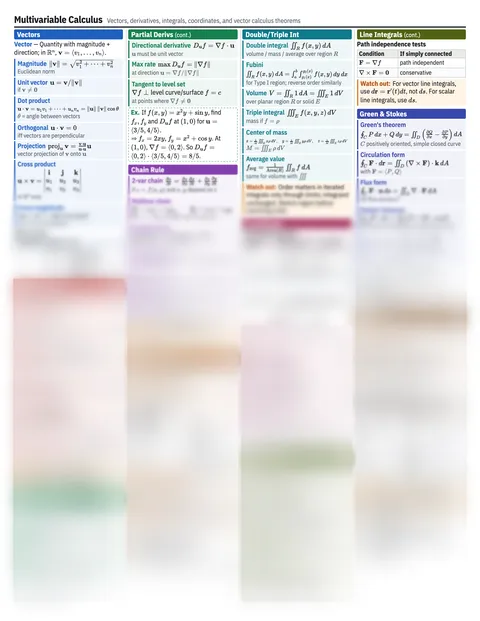
A one-page reference for the whole topic, fact-checked, with the first part free to read. This exam page does not repeat it. Use it to see the material, then make a shorter study sheet from the notes your section actually used.
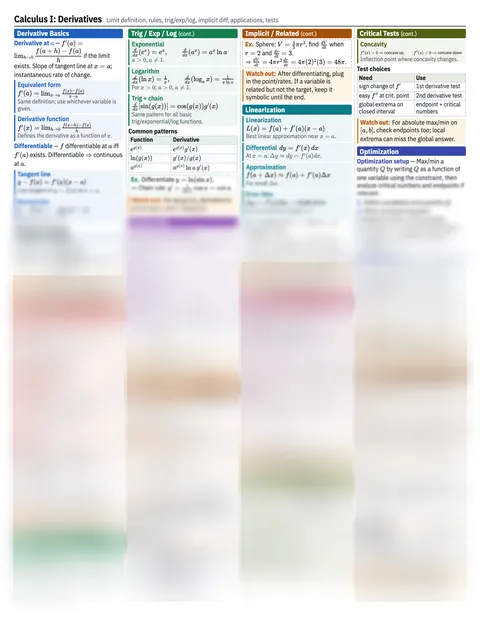
Calculus I: Derivatives reference sheet — the free part in text.
Unlock the full reference sheet to edit, print or save it as a PDF.
Make your own for this exam
Upload the Midterm 1 slides or the problem sets from those weeks, not the whole textbook. In the focus step, name the rules your instructor emphasized and anything the review session said to skip. A one-page sheet is the right size when the exam itself is one page of notes or a notecard; you can switch to front and back later if the syllabus allows it.
FAQ
Questions
- What should a Calculus I Midterm 1 study sheet prioritize?
- The limit definition, where derivatives fail to exist, the product and quotient rules written correctly, the chain rule, and the basic trig, exponential, and log derivatives. Leave related rates and optimization for the next exam unless your review list includes them.
- Can I bring a formula sheet to Calculus I Midterm 1?
- Only if your section says so. Handwritten one-side or index-card rules are common; printed sheets are often banned; some exams allow no notes at all. Check the syllabus or the exam cover sheet before you rely on one.
- How is this different from the derivatives library page?
- The library page is a full-course derivatives reference. This page is the first-midterm slice: what is usually in scope, what usually waits, and how to turn your own notes into a one-page study sheet.
Keep going
More study pages
All of these sit in the sheet library. Every exam study page.