Computer Networks final exam study sheet
A computer networks final mixes calculation with protocol behaviour: compute a delay, subnet an address block, trace a TCP congestion window, run a routing algorithm by hand. Many courses teach top-down, so the midterm covers the application and transport layers and the final adds the network and link layers. The final is usually cumulative, with the later layers carrying more of the points.
Depending on where you study, it is a crib sheet, an aid sheet, or your revision notes; in networks it is mostly delay formulas, header fields, and subnetting steps.
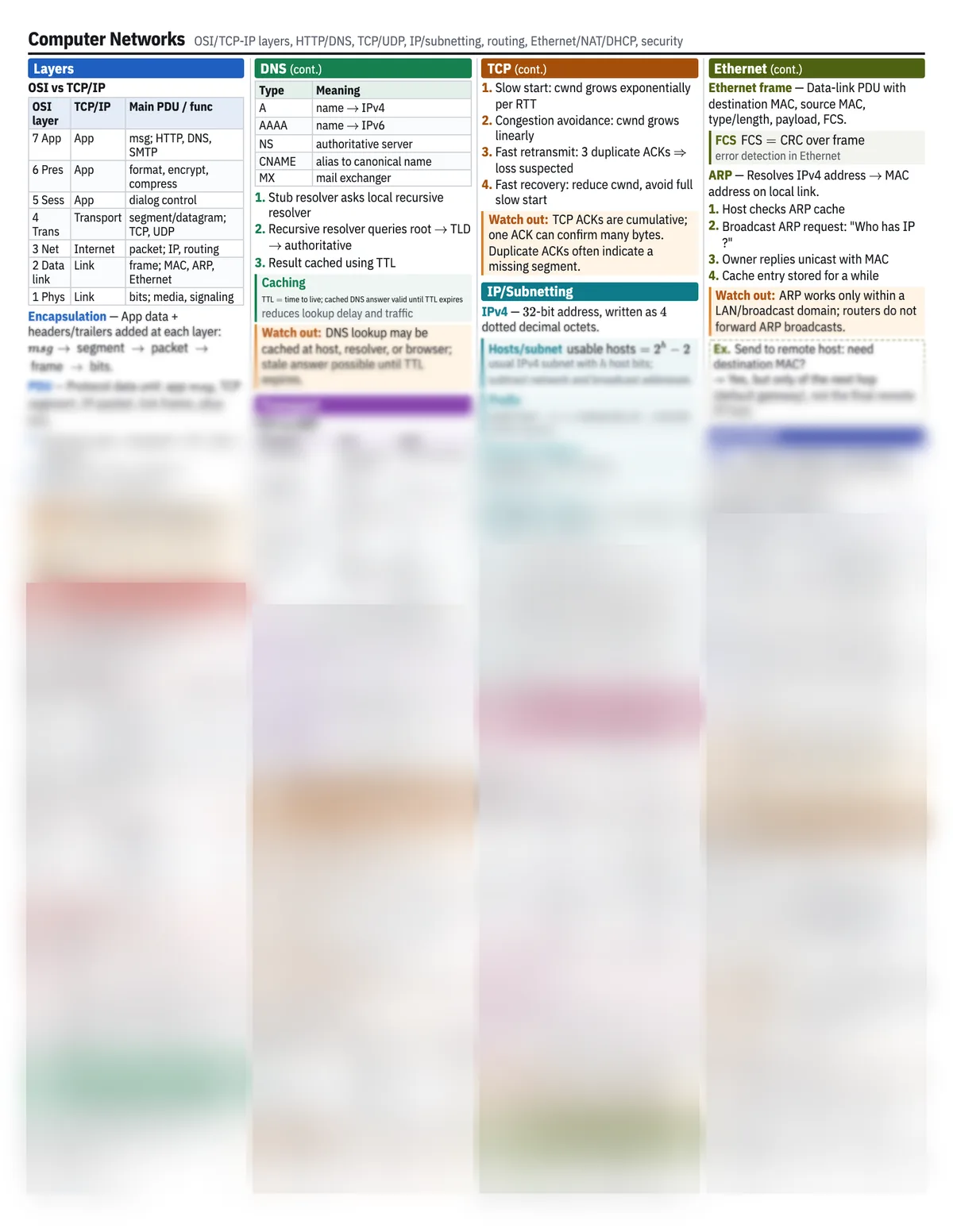 Cheat sheet locked
The scope
What this exam usually covers
These are the problem types a networks final often grades; whether your course runs top-down or bottom-up changes which came first.
- Delay and throughput Transmission delay L/R versus propagation delay d/s, end-to-end delay over several links, and throughput limited by the bottleneck link. Units, bits versus bytes and ms versus s, cost the most points.
- HTTP and DNS Persistent versus non-persistent HTTP and how many round trips a page with several objects takes, plus iterative versus recursive DNS resolution and what caching changes.
- TCP reliability The three-way handshake, sequence and acknowledgement numbers in a short exchange, and go-back-N versus selective repeat after a loss. Getting the next expected byte number right is the common trap.
- TCP congestion control Slow start, congestion avoidance, ssthresh, and what happens on a timeout versus three duplicate ACKs. Plotting the window size round by round is a standard question.
- IP addressing and subnetting CIDR prefixes, network and broadcast addresses, hosts per subnet as 2 to the host bits minus 2, and splitting a block into subnets of given sizes. Longest-prefix matching on a forwarding table.
- Routing Dijkstra link-state by hand and distance-vector updates with the Bellman-Ford equation. Some courses also ask about count-to-infinity and the split between intra-domain routing and BGP.
- Link layer MAC addresses, ARP, how a switch learns, Ethernet frames, and CSMA/CD. Some courses include CRC calculation or the efficiency of multiple-access protocols.
- NAT, DHCP, and security What NAT rewrites in each direction, the DHCP exchange, and the security goals of confidentiality, integrity, and authentication, with TLS as the usual example.
Usually later
Wireless and mobility, multimedia, software-defined networking, and detailed cryptography appear in some networks courses and not others, and the security unit is sometimes taught only in the last week. Check the review sheet for which chapters are on the final and whether the earlier layers are tested again in full.
The rules
What a note sheet is usually allowed to include
check your exam header — it wins
Networks finals often allow one page of notes or one side of a page, sometimes handwritten only, plus a basic calculator for delay and subnetting. Some are closed-notes and give the relevant formulas or header layouts on the paper. In Canada this is usually an aid sheet and in the UK a crib sheet, and some departments specify a size. The syllabus decides. This page is a study sheet either way: the subnetting and congestion-window problems only stick if you work them, not just list them.
The sheet
The matching library sheet
A one-page reference for the whole topic, fact-checked, with the first part free to read. This exam page does not repeat it. Use it to see the material, then make a shorter study sheet from the notes your section actually used.
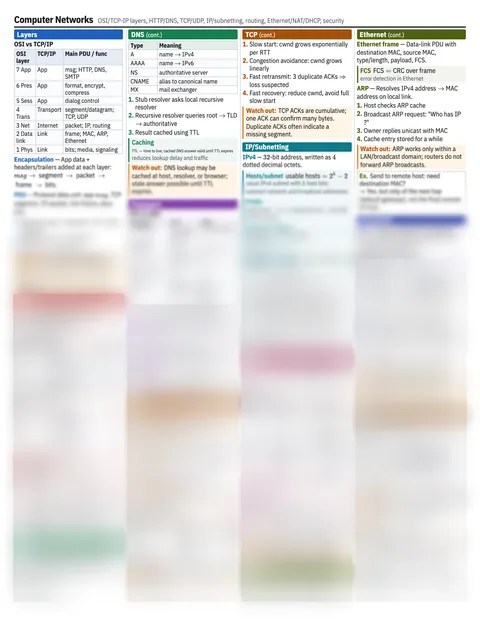
Computer Networks reference sheet — the free part in text.
Unlock the full reference sheet to edit, print or save it as a PDF.
Make your own for this exam
Upload the lecture slides, problem sets, and any lab traces the final covers. In the focus step, name what the review session stressed, such as subnetting or TCP congestion control. Pick one page, front and back, or an index card to match what your course allows.
FAQ
Questions
- What goes on a computer networks formula sheet?
- Transmission and propagation delay, end-to-end delay, the hosts-per-subnet rule, TCP handshake and congestion-control rules, the Bellman-Ford update, and a short table of which layer each protocol belongs to and its port where relevant.
- Can I bring a crib sheet to a computer networks final?
- Only if your course allows one. A single page or one side of notes is common in networks courses; some finals are closed-notes and print the formulas they need. Check the syllabus first.
- How do I get subnetting questions right?
- Convert the prefix to a block size, write the boundaries out, and check each subnet's network and broadcast address. Most errors come from forgetting to subtract two for the network and broadcast addresses.
- How is this different from the computer networks library sheet?
- The library sheet is a course-wide reference for layers, HTTP and DNS, TCP and UDP, IP and subnetting, routing, Ethernet, NAT and DHCP, and security. This page covers what the final usually grades and how to build a sheet from your notes.
Keep going
More study pages
All of these sit in the sheet library. Every exam study page.