Machine Learning final exam study sheet
A machine learning final is mostly derivation and short computation: write a loss, take its gradient, compute an information gain, say what a regularizer does to the weights. Midterms often stop at linear and logistic regression and the bias-variance discussion. The final is usually cumulative, with the later models (SVMs, neural networks, unsupervised learning) carrying more weight.
A formula sheet in most courses, a crib sheet or an aid sheet in others: one page of losses, gradients, and the conditions that tell you which model to use.
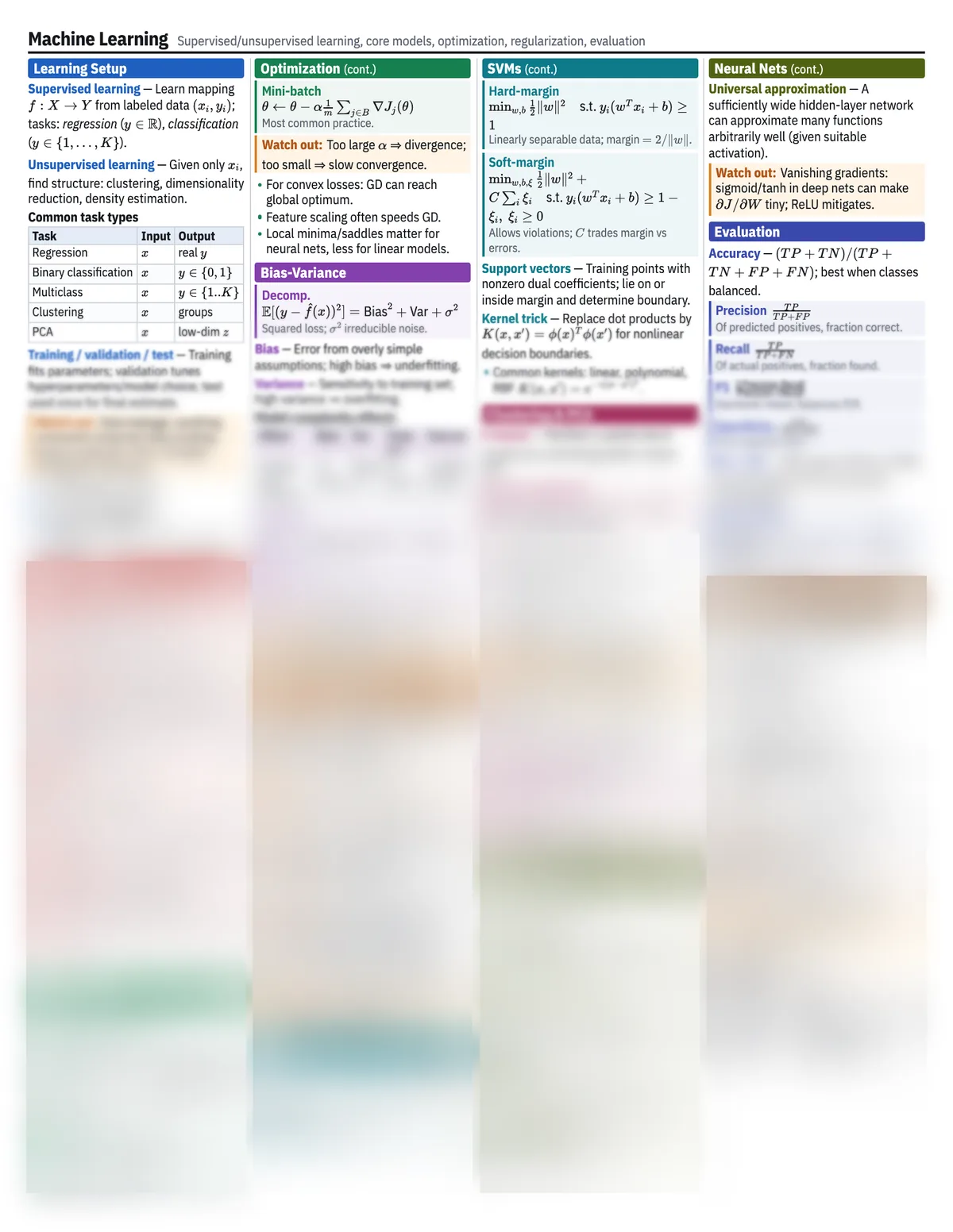 Cheat sheet locked
The scope
What this exam usually covers
These are the question types a machine learning final often grades; the mix of math and conceptual questions varies a lot by course.
- Linear and logistic regression Write the MSE and log-loss objectives, the normal equation, and the gradient of each. Logistic regression has no closed form, so the exam asks for the gradient step instead.
- Gradient descent One update step by hand with a given learning rate, and batch versus stochastic versus mini-batch. Signs matter: the update subtracts the gradient times the learning rate.
- Bias, variance, and regularization Read a training-versus-validation error curve and say whether the model is over- or underfitting. L2 shrinks weights, L1 drives some to zero; increasing lambda raises bias and lowers variance.
- Decision trees and ensembles Compute entropy or Gini and the information gain of a split on a small table. Bagging and random forests reduce variance; boosting mainly reduces bias.
- Support vector machines Margin, support vectors, the role of C in the soft-margin SVM, and what the kernel trick buys. Some courses ask for the hard-margin primal and its constraints.
- Neural networks A forward pass through a small network, common activations and their derivatives, and one backpropagation step using the chain rule. Shape mismatches in weight matrices are a common error.
- Clustering and PCA Run k-means for an iteration by hand, explain why the result depends on initialization, and interpret principal components as directions of greatest variance from the covariance matrix.
- Evaluation and validation Precision, recall, F1, and accuracy from a confusion matrix, ROC and AUC, and k-fold cross-validation. Accuracy on an imbalanced dataset is the trap these questions set.
Usually later
Probabilistic models (naive Bayes, Gaussian mixtures, EM), convolutional and recurrent networks, reinforcement learning, and learning theory appear in some ML courses and not in others. The library sheet covers the core models, so add any of these from your own notes if your course taught them, and check the review sheet for the final's emphasis.
The rules
What a note sheet is usually allowed to include
check your exam header — it wins
Machine learning finals often allow one page of notes, sometimes both sides, and many students use it as a formula sheet for the losses, gradients, and metric definitions. Some graduate-level courses are open-notes; others are closed-book and give the key equations on the exam. A calculator may or may not be allowed for the entropy questions. In Canada this is often an aid sheet and in the UK a crib sheet. The syllabus decides. This page is a study sheet either way: deriving each gradient once yourself is the real preparation.
The sheet
The matching library sheet
A one-page reference for the whole topic, fact-checked, with the first part free to read. This exam page does not repeat it. Use it to see the material, then make a shorter study sheet from the notes your section actually used.
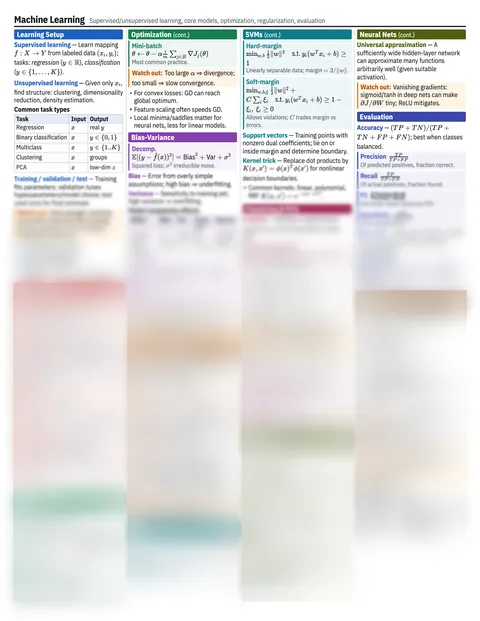
Machine Learning reference sheet — the free part in text.
Unlock the full reference sheet to edit, print or save it as a PDF.
Make your own for this exam
Upload the lecture slides, problem sets, and any derivation notes the final covers. In the focus step, name what the review session stressed, for example backpropagation or SVM margins. Choose one page, front and back, or an index card to match your course's rule.
FAQ
Questions
- What goes on a machine learning formula sheet?
- The MSE and log-loss objectives and their gradients, the normal equation, the sigmoid and its derivative, entropy, Gini, and information gain, the L1 and L2 penalty terms, the k-means objective, and precision, recall, and F1. Add the conditions for when each model fits the problem.
- Can I bring a crib sheet to a machine learning final?
- Often, but it depends on the course. One page of notes is common; some finals are open-notes and some are closed-book with key equations provided. Check the syllabus or ask the instructor.
- Do I need to memorize derivations for an ML final?
- Usually you need to reproduce the short ones, such as the gradient of MSE or log loss and one backpropagation step. Writing each derivation once while studying makes it much faster on the exam.
- How is this different from the machine learning library sheet?
- The library sheet is a course-wide reference for supervised and unsupervised learning, core models, optimization, regularization, and evaluation. This page covers what the final usually grades and how to build a sheet from your own course notes.
Keep going
More study pages
All of these sit in the sheet library. Every exam study page.