Operating Systems final exam study sheet
An operating systems final is part calculation and part reasoning about concurrency. You draw a Gantt chart for a scheduler, split an address into page number and offset, count page faults under LRU, and find the race in a short piece of code. Midterms usually cover processes, threads, scheduling, and synchronization; the final is usually cumulative but weights memory management and file systems, which came later.
Call it a crib sheet, an aid sheet, or a formula sheet: for this course it holds the formulas for address translation and access time and the shapes of the classic synchronization problems.
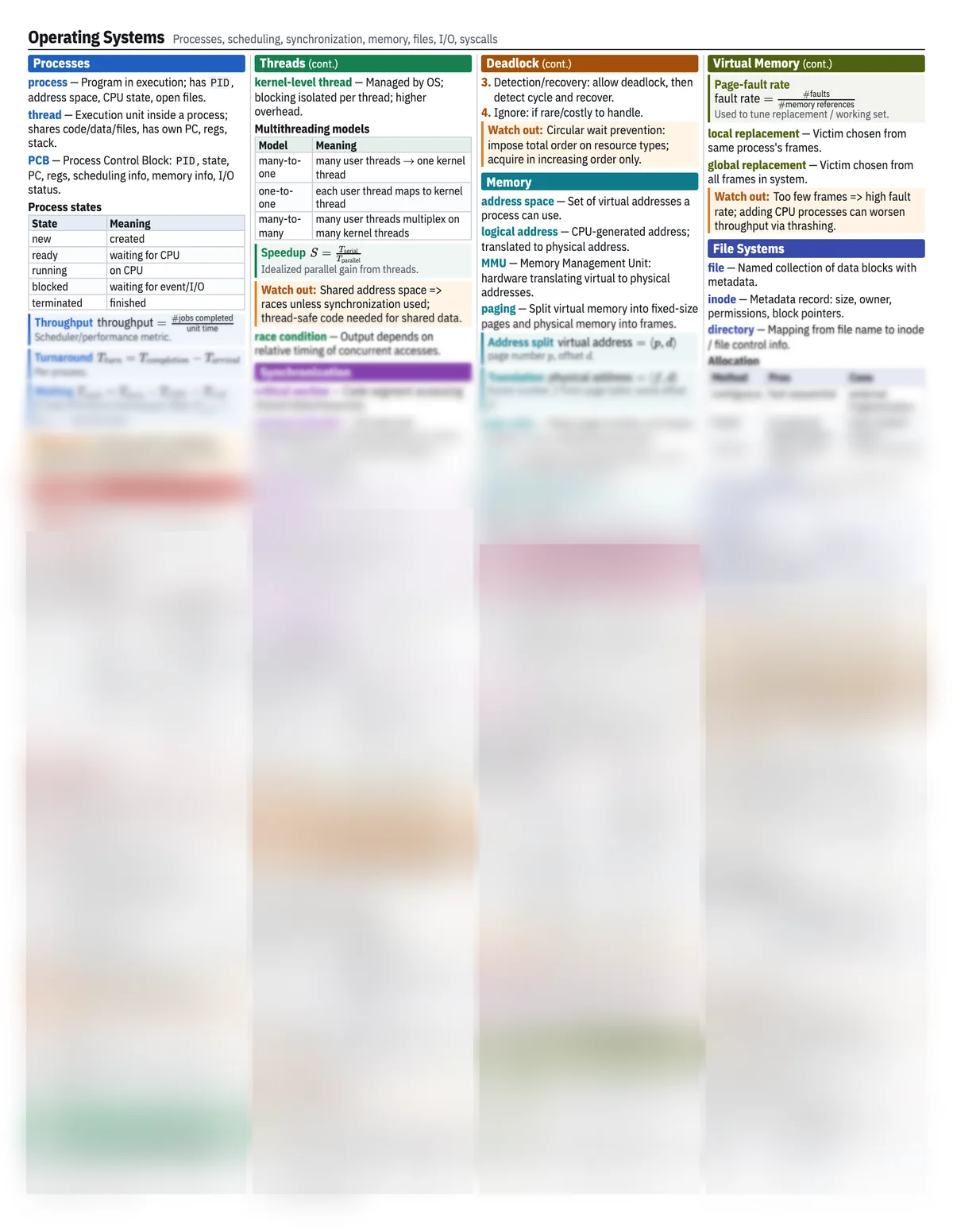 Cheat sheet locked
The scope
What this exam usually covers
These are the problem types an operating systems final often grades; your course's textbook and labs will shift the balance.
- CPU scheduling Gantt charts for FCFS, SJF, SRTF, priority, and round robin, then average waiting and turnaround time. Points go on the round-robin queue order when a new process arrives at the same moment a quantum expires.
- Processes and threads Process states and transitions, what fork() returns in parent and child, and counting how many processes a loop of fork() calls creates. What threads share and what each has privately.
- Synchronization Find the race condition, then fix it with a lock, semaphore, or condition variable. Producer-consumer with bounded buffer and readers-writers are the standard problems, and wait order is where deadlocks creep in.
- Deadlock The four necessary conditions, resource-allocation graphs, and the banker's algorithm safety check with Need = Max minus Allocation. Arithmetic slips in the Work vector are the usual lost marks.
- Paging and address translation Split a virtual address into page number and offset given page size, compute page-table size, and use effective access time with a TLB hit ratio. Mixing bits and bytes is the common error.
- Page replacement Count faults for FIFO, LRU, and optimal on a reference string with a given number of frames. Belady's anomaly applies to FIFO, not LRU, and thrashing is tied to the working set.
- File systems Inodes with direct and indirect blocks, computing the largest file size from block size and pointer size, hard versus symbolic links, and free-space tracking.
- I/O and disk Interrupts, DMA, and system calls as the user-to-kernel boundary. Some courses still ask for disk scheduling (SSTF, SCAN, C-SCAN) head-movement totals.
Usually later
Disk scheduling, RAID, virtualization, distributed systems, and security are taught in some OS courses and dropped in others. Multi-level page tables and journaling are sometimes only in the lecture notes, not on the exam. Check the review sheet for which topics the final emphasizes and whether it is weighted to the post-midterm material.
The rules
What a note sheet is usually allowed to include
check your exam header — it wins
Operating systems finals commonly allow one page of notes, often handwritten and sometimes both sides, because the exam is about applying the algorithms rather than recalling them. Others are closed-notes, and some allow a calculator for the access-time and address-size questions. Canadian courses often call this an aid sheet, UK courses a crib sheet. The syllabus decides. This page is a study sheet either way: practise the scheduling and paging problems from it, not just copy it.
The sheet
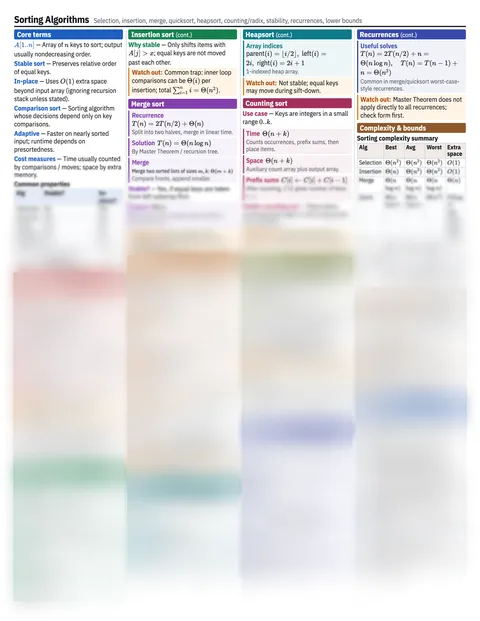
The matching library sheet
A one-page reference for the whole topic, fact-checked, with the first part free to read. This exam page does not repeat it. Use it to see the material, then make a shorter study sheet from the notes your section actually used.
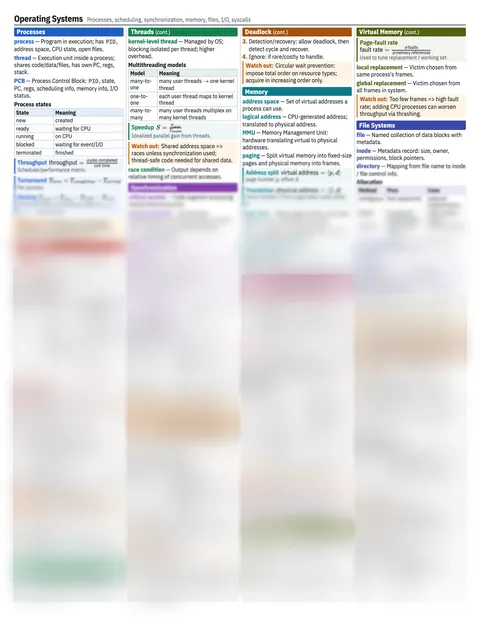
Operating Systems reference sheet — the free part in text.
Unlock the full reference sheet to edit, print or save it as a PDF.
Make your own for this exam
Upload the lecture slides, problem sets, and any lab write-ups the final covers. In the focus step, name what the review session stressed, for example the banker's algorithm or page-fault counting. Choose one page, front and back, or an index card to match your course's rule.
FAQ
Questions
- What goes on an operating systems formula sheet?
- Waiting and turnaround time definitions, the round-robin rules, Need = Max minus Allocation and the safety loop, the address-split formulas, effective access time with a TLB, the inode maximum-file-size calculation, and the semaphore patterns for producer-consumer and readers-writers.
- Is an aid sheet allowed in an operating systems final?
- In many courses, yes, typically one page, often handwritten. Some are closed-notes. The course syllabus or exam instructions decide, so check before you rely on one.
- How do I avoid mistakes in page-fault counting?
- Write the frame contents after every reference in a table and mark each fault. For LRU, track the last-use time of each page rather than guessing; most errors come from skipping a column.
- How is this different from the operating systems library sheet?
- The library sheet is a course-wide reference for processes, scheduling, synchronization, deadlock, memory, file systems, and I/O. This page covers what the final usually grades and how to build a sheet from your own notes.
Keep going
More study pages
All of these sit in the sheet library. Every exam study page.